For patients
Before your surgery, ask: “Can both of my arms be measured now, so there is something to compare with later?” It is a reasonable request, and it protects you.
Arm swelling after breast cancer
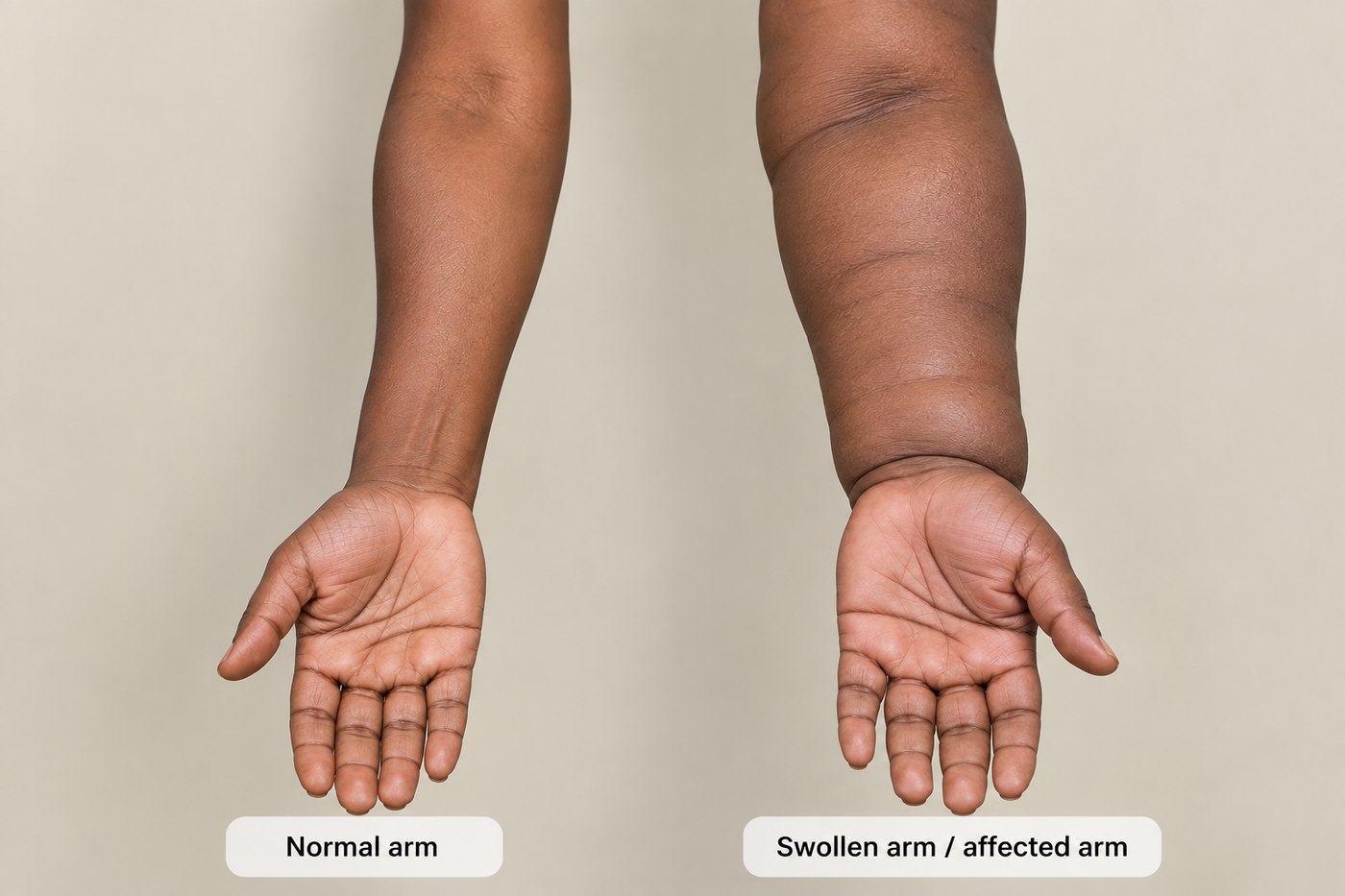
Swelling of the arm after breast cancer treatment is called lymphoedema. It happens because surgery or radiotherapy to the armpit disturbs the arm's drainage. It is common, it can appear months or years after treatment, and caught early it is very manageable.
Why it happens
The lymph nodes in the armpit are where fluid from the arm, breast and chest wall drains before returning to the bloodstream.
Breast cancer treatment often involves those nodes. Removing them tells the surgeon whether the cancer has spread, and radiotherapy to the area reduces the chance of it returning. Both are often essential. Both also reduce the arm's capacity to drain.
For many women the remaining vessels cope. For others, drainage falls short and fluid collects in the tissues. It can affect the hand, forearm or whole arm, and also the breast, chest wall and side of the trunk — areas where swelling is easily mistaken for ordinary post-surgical change.
Who is at risk
Risk is not the same for everyone, and it does not end when treatment ends.
Removal of many lymph nodes from the armpit carries the highest risk — around one woman in five goes on to develop arm lymphoedema.
Removal of only the first one to three nodes. The risk is considerably lower, but it is not zero.
Radiotherapy directed at the armpit and surrounding lymph node regions adds to the risk, particularly when combined with node removal.
Higher body weight, infection in the arm after surgery, and complications such as fluid collecting in the armpit all raise the likelihood.
The risk is lifelong. Most arm lymphoedema appears within the first two to three years after treatment, but it can first develop many years later. A woman treated a decade ago who notices a newly heavy arm should not assume it cannot be related.
Early signs
At the earliest stage the arm looks completely normal. What you feel comes first. That is precisely when treatment works best.
Early lymphoedema can often be controlled with a well-fitted compression sleeve and exercise alone, and sometimes reversed. Left alone, it tends to become permanent and harder to treat.
Noticed any of these on your treated side? Early arm lymphoedema is very treatable — get it checked.
Book an assessmentBefore surgery
The single most useful thing a surgical team can do costs almost nothing and takes minutes.
Lymphoedema is diagnosed partly by comparing the treated arm with how it was before. Without a measurement taken before surgery, there is nothing to compare against — and small, early, treatable changes go unnoticed until they are large enough to see.
A baseline measurement of both arms before surgery, repeated at intervals afterwards, lets swelling be detected while it is still subtle — and treated before it becomes established.
Before your surgery, ask: “Can both of my arms be measured now, so there is something to compare with later?” It is a reasonable request, and it protects you.
Referring for baseline measurement and pre-operative education before axillary surgery is the highest-value lymphoedema referral there is. It turns a late, difficult diagnosis into an early, manageable one.
Urgent
Infection. If the arm becomes suddenly red, hot, painful or tender, or you develop fever or chills, seek medical care the same day. Cellulitis in an arm at risk of lymphoedema needs prompt antibiotics, and each episode can worsen lymphatic damage.
Sudden new swelling. Swelling that appears suddenly, particularly with pain or with a new lump in the armpit, neck or above the collarbone, should be reviewed promptly by your oncology team. It may be lymphoedema — but it can also signal a blood clot or, occasionally, the return of cancer, and those need to be excluded first.
Do not start compression bandaging or massage on an arm with active infection or an unexplained sudden swelling until it has been medically assessed.
What you can still do
Much of the traditional advice given to women after breast cancer treatment was cautious rather than evidence-based. Some of it has changed.
Research has shown that strength training, started gently and increased gradually under guidance, does not cause lymphoedema and can reduce flare-ups in women who already have it. Build up slowly, and stop and seek advice if the arm feels heavier afterwards.
The opposite. Regular movement and exercise help the remaining lymphatic vessels drain the arm. Muscle contraction is one of the main ways lymph is moved at all.
Where there is a choice, many clinicians still suggest using the other arm, and that is a reasonable precaution. But the evidence that a needle or blood pressure cuff causes lymphoedema is weak, and it should never delay care you need.
Lymphoedema has no known definite cure, but it is effectively manageable and controllable — especially when caught early, when a compression sleeve and exercise can be enough to keep it in check.
Look after the skin. Keep it moisturised, wear gloves for gardening, and treat any cut or bite promptly. Infection is one of the few things reliably shown to worsen lymphoedema.
Treatment
What is needed depends on the stage. Early lymphoedema needs far less than established swelling.
A properly measured compression sleeve, often with a glove or gauntlet for the hand. Early on, this alone can control the swelling. Garments must be fitted by someone trained — a sleeve that is too tight at the top can make things worse.
For established swelling, an intensive phase of manual lymphatic drainage and multilayer bandaging to reduce the arm's size, followed by garments to hold the reduction.
Specific exercises performed while wearing compression, plus general activity and progressive strength work. Movement is part of the treatment, not a risk to be managed.
Daily moisturising, prompt attention to cuts, and learning to recognise early signs of infection. Much of long-term care is done by the woman herself, once she has been properly taught.
Surgical options such as lymphaticovenous anastomosis and lymph node transfer exist for selected patients. Where available, they complement conservative care rather than replacing it, and compression is usually still needed afterwards.
For clinicians and health teams: Dr. Janet Mwau runs lymphoedema training and structured certification for hospitals, county health teams, oncology units and training colleges. Arrange training
Getting help
Whether you finished treatment last month or fifteen years ago, and whether or not anyone else can see a difference. Early arm lymphoedema is one of the most treatable conditions in cancer survivorship — if it is caught.